

Many crypto traders assume all large exchanges behave the same: custody is safe, interfaces are interchangeable, and derivatives are simply risk turned up. That’s a useful shorthand but a dangerous one. OKX combines a centralized exchange (CEX), a non-custodial Web3 wallet, an NFT marketplace, and derivatives infrastructure — and those different pieces follow different rules, incentives, and failure modes. Understanding how those layers interact is the core competence for any trader who wants to log in, hedge, stake, or move assets across chains without being surprised.
This article explains the mechanisms that distinguish OKX’s product stack, corrects common misconceptions about custody and leverage, and gives US-based traders decision-useful heuristics for when to use the centralized rails versus the self-custodial Web3 options. It also touches on a recent platform housekeeping move — a small delisting of low-volume spot pairs — to illustrate why exchanges prune listings and what that implies for liquidity-sensitive strategies.
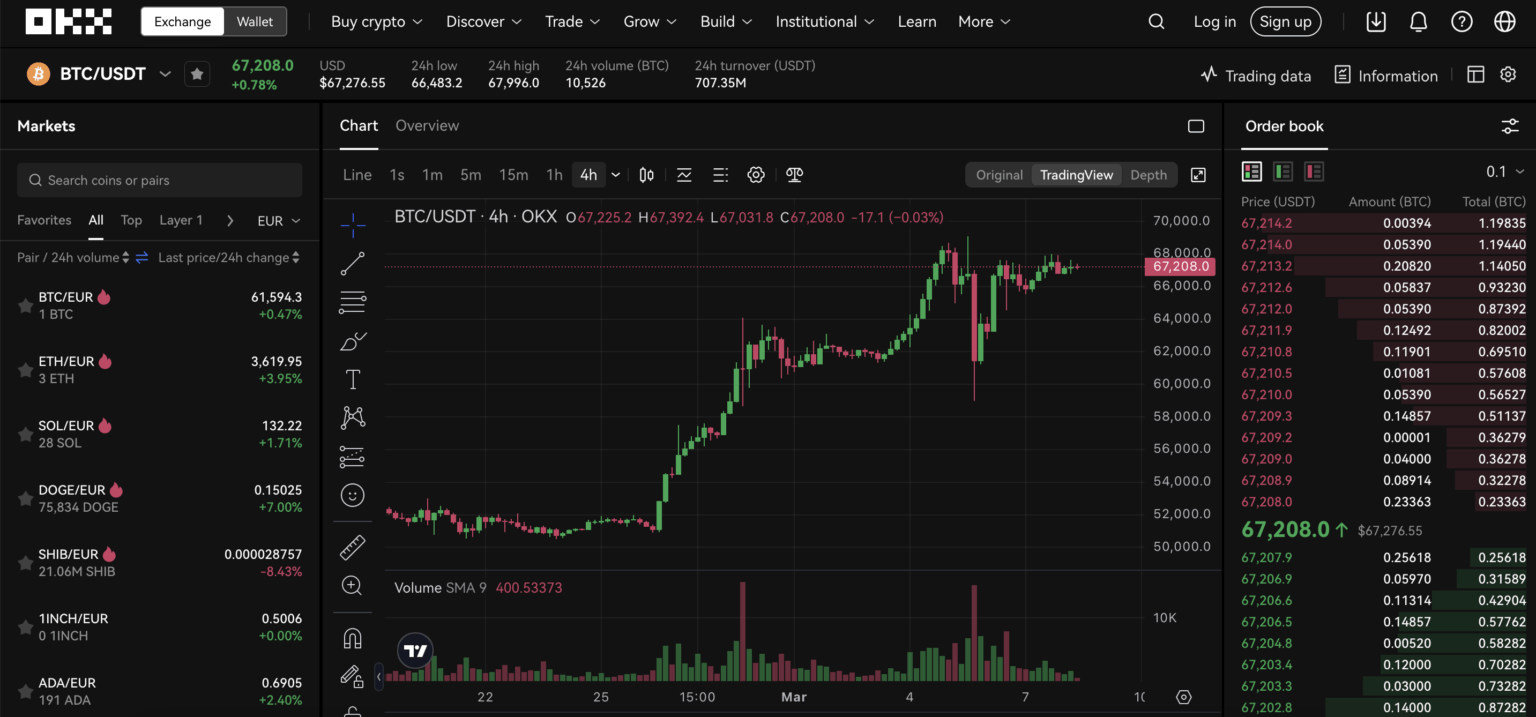
How OKX Actually Works: Mechanisms, Not Marketing
At the core are two different custody paradigms operating under one brand. The centralized exchange side holds user deposits and executes order matching, margin, and futures — this is where standard exchange protections apply: cold storage for the bulk of reserves, hot wallets for settlement, and an internal ledger tracking user balances. OKX reports that over 95% of assets are held in air-gapped cold storage protected by multi-signature procedures; that reduces the rate and scale of hot-wallet theft but does not eliminate operational risk.
Parallel to that, OKX runs a self-custodial Web3 wallet that gives users complete control of their private keys via a seed phrase and supports hardware devices like Ledger and Trezor. Mechanistically, these two worlds intersect: moving tokens from a self-custodial wallet to the exchange requires on-chain transactions and then KYC/account plumbing for trading; moving from the exchange to the wallet subjects your withdrawal to the exchange’s withdrawal approvals and cold-wallet processes. That intersection point is where many practical errors happen — delayed withdrawals, unexpected fees, or exposure to phishing when users are switching interfaces.
Futures and Margin: Leverage Is a Tool, Not a Feature
One persistent myth is that higher leverage is “better” because it increases potential returns; in practice, leverage is a risk-amplifier that interacts with liquidity, funding rates, and maintenance margin rules. OKX offers futures and perpetual swaps with up to 125x leverage on certain assets — a headline that attracts attention but should prompt questions, not orders. Mechanically, high leverage compresses the margin buffer: small market moves, slippage on low liquidity, or a sudden change in funding can trigger liquidation. For US-based traders, regulatory constraints may also limit product availability; always check which instruments are accessible to your jurisdiction and account type.
Practical heuristics: if you trade perpetuals, treat the maintenance margin as the real cost, not the initial margin. On quarterly futures, the delivery mechanism and calendar risk matter; a quarter-end squeeze can widen spreads and cause unexpected slippage. For marginal positions, use isolated margin when you want to cap the risk to a single position; use cross-margin only if you understand the contagion path across positions on your account.
Web3 Features: Power with a Different Failure Mode
OKX’s Web3 wallet and DEX aggregator give access to DeFi liquidity across more than 130 blockchains and aggregate liquidity from protocols like Uniswap for optimal swap routing. Mechanistically, an aggregated DEX routes a trade across multiple pools to minimize slippage and fees. That improves execution for some cross-chain swaps but brings smart contract risk and bridging risk. If you use the wallet to farm yield, remember that auto-compounding and lock-up staking change your liquidity profile — rewards can look attractive, but lock-ups and impermanent loss are concrete trade-offs.
Crucial distinction: centralized holdings benefit from exchange custodial controls and PoR (Proof of Reserves) transparency that OKX provides to show backing for deposited assets. Self-custodial holdings transfer counterparty risk to smart-contract and user-key-management risk. In short, custody is not better or worse universally — it’s different. Choose the custody model that aligns with your threat model: theft by an exchange, or theft/loss through phishing, lost seeds, and smart-contract exploits.
Security, Login, and Practical Steps for US Traders
Login and account protection are a practical battleground for attackers. OKX implements mandatory Two-Factor Authentication (2FA), AI-driven threat detection, and biometric options on mobile — these features materially reduce credential-stuffing and account-takeover risk. But they are not magic. The most common human errors are: reusing passwords, neglecting hardware wallet use for large balances, and approving malicious wallet transactions after clicking a phishing link.
If your goal is to sign in and trade efficiently, make the login process part of a routine: enable hardware 2FA, register biometrics on your phone only if that device is physically secure, and maintain a cold backup of your 2FA seed and Web3 wallet phrase in a physical form. When moving assets between the exchange and your self-custodial wallet, mentally double-check the destination address and gas estimates — many US traders are surprised by cross-chain fees and wait times during network congestion.
To practice this seriously, use a small transfer as a canary: send a token amount on-chain first, confirm receipt and timing, then send the larger balance. If you need to log in to OKX now, the exchange’s login flows and step-by-step KYC are straightforward for most US users; here is a direct help page for the entry route: okx login.
Misconceptions Corrected
Misconception 1 — “Proof of Reserves means funds are instantly redeemable.” Correction: PoR proves backing at a snapshot and increases transparency, but it does not remove operational withdrawal limits, network congestion delays, or the exchange’s internal risk controls.
Misconception 2 — “High leverage on platform X is the same as on platform Y.” Correction: Maintenance margin formulas, liquidation engines, and insurance funds differ. Two platforms offering 125x can have very different liquidation frequencies because of order matching engines and funding-rate dynamics.
Misconception 3 — “Using the Web3 wallet is safer because I control the keys.” Correction: Controlling keys removes counterparty risk but exposes you to human error and smart-contract risk; safety depends on how well you manage keys and vet contracts.
When OKX’s Delisting Notice Matters
Exchanges periodically delist low-volume or riskier tokens; OKX recently removed several spot pairs (RSS3, MemeFi, GHST, RIO, SWEAT). Mechanistically, delisting reduces the exchange’s market-making burden and concentrates liquidity into more active markets. For traders this means two things: first, if you hold small-cap tokens, on-exchange liquidity can vanish quickly, so maintain off-exchange exit plans (limit orders or bridging to other venues). Second, delistings are routine risk management, not necessarily a signal of insolvency — but persistent delistings across many exchanges can be a market signal that a token’s ecosystem and liquidity are deteriorating.
Decision-Useful Takeaways and a Simple Heuristic
One reusable mental model: ask three custody questions before every action — who controls the private key, who validates withdrawals, and what are the fallback recovery options? If the answer includes “third-party custody” and “exchange withdrawal approvals,” expect operational delays but less absolute responsibility for seed safety. If it includes “you hold the seed,” expect faster on-chain moves but absolute responsibility for key backups.
Risk budgeting framework: allocate only a small fraction of capital to high-leverage futures, maintain a “cold reserve” on hardware or within exchange cold-storage-sized amounts, and treat DeFi yield allocations as time-locked bets with explicit loss scenarios (impermanent loss, hack, or exploit). Use isolated margin limits per trade and always size positions using maintenance-margin tolerances rather than initial margin.
What to Watch Next
Signals that would change tactical behavior: an increase in exchange-wide liquidations (systemic risk), large changes in Proof of Reserves cadence or methodology (transparency signal), or expanded hardware wallet integrations that reduce friction for US users. Also monitor listing/delisting patterns across exchanges — a cluster of delistings for a token is a clearer liquidity signal than one-off removals.
Finally, for US traders, regulatory evolution remains a background constraint. Product availability and leverage caps will shift with policy and enforcement. Traders should treat current access levels as contingent and design strategies that can migrate positions or unwind quickly if products are restricted.
FAQ
Is my money safer on OKX’s centralized exchange or in the Web3 wallet?
“Safer” depends on the threat. Centralized custody protects you from lost seed phrases and provides PoR transparency and cold-storage safeguards; it exposes you to exchange operational risk and the need to trust procedures. Self-custody eliminates counterparty risk but adds responsibility for key management and exposes you to smart-contract and phishing risks. Pick the model that matches which failure you are least willing to accept.
How should I approach OKX futures if I live in the US?
Confirm which derivatives are available to US accounts, read the maintenance margin rules, and size positions around the maintenance requirement, not the initial margin. Prefer isolated margin for single-trade risk control, and test your liquidation sensitivity with small positions first.
Do delistings mean OKX is tightening standards?
Yes — removing low-volume or high-risk pairs is routine operational housekeeping. It reduces the exchange’s market-making and surveillance load and can be a sign of stricter listing standards. However, widespread delistings across exchanges should be viewed as a market signal rather than a single-exchange problem.
What are practical steps to secure my account login?
Enable 2FA (hardware 2FA where possible), use unique passwords stored in a hardware-backed password manager, register device biometrics only on secure personal devices, and verify URLs or bookmarks before logging in. For large balances, consider keeping most funds in cold storage or a hardware wallet integrated with the exchange where possible.
